A while back, I found myself thinking about this: right now, as you're reading this text, trillions of tiny living beings are at work inside your body. Not bacteria, not parasites — but a part of your very own cells that, billions of years ago, were once fully independent organisms. They're called mitochondria, and their story is one of the strangest chapters in the history of biology.
If you learned anything about mitochondria in school, it was probably that famous line: "the mitochondria is the powerhouse of the cell." That's true, but it's only the tip of the iceberg. The reality is that mitochondria are far more than a power plant; your fate of aging, the way your cells die, even your risk for certain diseases, are all tied to this tiny organelle.
An Ancient Guest in the Cell's House
The story begins around 1.5 to 2 billion years ago. According to the well-known "endosymbiotic theory," first seriously proposed by Lynn Margulis, mitochondria were once an independent bacterium with a remarkable ability: it could use oxygen to produce energy. At a time when Earth's atmosphere had recently filled with oxygen — a gas that was toxic to many organisms — this bacterium held a winning card.
A larger cell engulfed this bacterium. But instead of being digested, the two organisms entered a strange partnership. The bacterium provided the host with extra energy, and the host provided the bacterium a safe environment. This accidental marriage became the starting point for all eukaryotic life on Earth — from fungi to plants to humans.
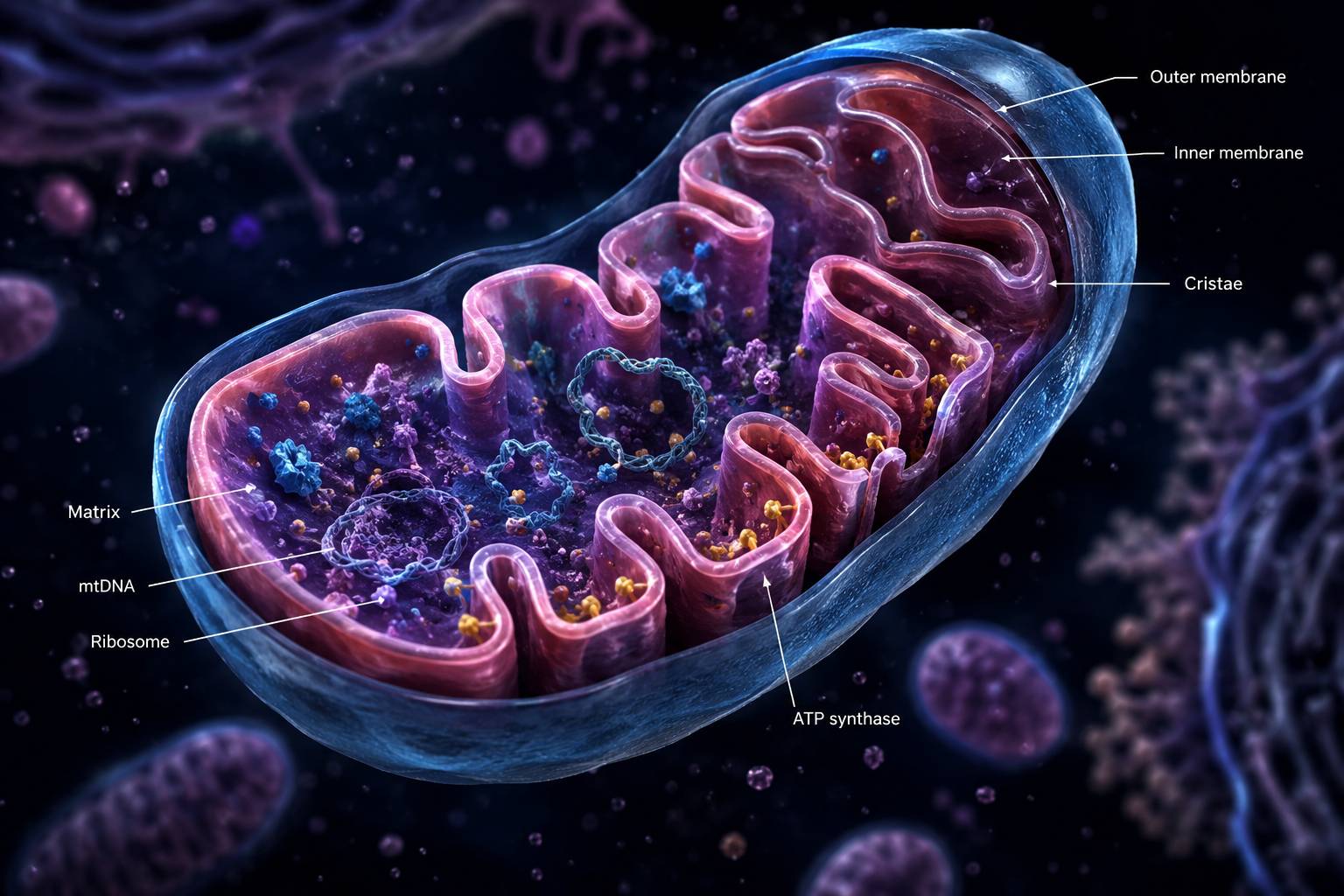
Evidence of this story still lives on in your cells today: mitochondria have their own DNA, completely separate from the DNA in the cell's nucleus. They also have a double membrane — exactly what you'd expect if one cell had engulfed another. Even mitochondrial ribosomes resemble bacterial ribosomes more than human cell ribosomes.
A Power Plant That's Really a Power Plant
Now let's get to the famous part of the story. Every cell in your body (except red blood cells) needs energy to do its work — from muscle contraction to nerve signal transmission to protein synthesis. This energy is stored in a molecule called ATP, and most of a cell's ATP production happens in the mitochondria.
The process behind this is called "oxidative phosphorylation." In short, mitochondria use the oxygen you breathe and the food molecules you eat to create an electrical gradient across their inner membrane. This gradient works like water behind a dam; when released, its energy is converted into ATP molecules by an enzyme called ATP synthase.
Here's an interesting number: an adult human produces and consumes an amount of ATP roughly equal to their own body weight every day. That means your mitochondria make, recycle, and reuse around 60 to 70 kilograms of energy molecules daily. If this cycle stopped for even a minute, your cells would face an energy crisis.
More Than Just a Battery
This is where the story gets more interesting. If mitochondria were just a battery, you probably wouldn't have kept reading this far. But this organelle has other remarkable roles too.
Regulating cell death: Mitochondria are key players in a process called apoptosis, or programmed cell death. When a damaged or cancerous cell is detected, mitochondria can open their gates and release substances that trigger the cell's self-destruct mechanism. This is a vital defense system; disruption of it is one of the reasons cancer cells grow uncontrollably.
Heat production: In brown fat tissue (a type of fat abundant in infants and some hibernating animals), mitochondria can convert energy directly into heat instead of ATP, to keep body temperature stable in the cold.
Cellular signaling: Mitochondria communicate with the cell nucleus and other organelles, playing a role in regulating immune responses, metabolism, and even cellular stress.
Maternal inheritance: Another interesting fact is that your mitochondrial DNA comes almost entirely from your mother, not your father. That's why scientists use mitochondrial DNA to trace maternal lineage in human populations and even study ancient human migrations.
When the Power Plant Runs Into Trouble
Since nearly every cell in the body depends on mitochondria, dysfunction can have wide-ranging consequences. Mitochondrial diseases cover a range of rare genetic disorders that can affect muscles, the brain, the heart, and the nervous system — tissues with the highest energy demands.
Beyond that, research shows that mitochondrial efficiency declines with age, and this decline has been linked to the aging process and several age-related diseases such as Alzheimer's, Parkinson's, and type 2 diabetes. That's why "mitochondrial health" has become a hot topic these days in the fields of longevity and metabolic health.
The good news is that mitochondria aren't fixed; they can grow, divide, and even regenerate throughout your life. Exercise — especially aerobic training and high-intensity interval training — is well known to increase both the number and efficiency of mitochondria in muscle cells, one of the reasons endurance athletes experience such high levels of energy and stamina.
Why Does This Matter?
You might wonder why we should think so much about a microscopic organelle. The answer is that mitochondria are a perfect example of one of biology's most beautiful ideas: cooperation over competition. Two independent living organisms, instead of destroying each other, formed an alliance that became the foundation of all complex life on Earth.
This small organelle reminds us that even at the cellular level, survival is often the result of cooperation, not just competition. And perhaps, beyond all the biochemical details, that's the real reason mitochondria are so fascinating: a story of two strangers who decided, billions of years ago, to stay together — and that decision made you possible.